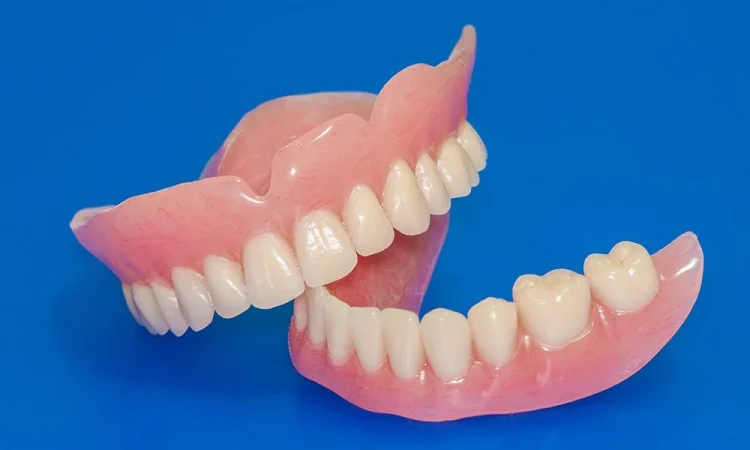
False teeth are older than the Roman Empire. By roughly 700 BC, craftsmen in northern Italy were already solving the same problem that billions of people deal with today, and the solutions they came up with were stranger, more resourceful, and more morbid than almost anything you’d expect. The story of dentures is not a neat line of progress. It’s a series of improvised answers to a universal problem, punctuated by accidental breakthroughs and at least one battlefield worth of harvested teeth.
What follows is a look at how humanity’s approach to tooth replacement evolved over roughly 27 centuries, and what that history reveals about where the technology stands right now.
The Ancient World’s Surprisingly Resourceful Fix
Dentures trace their roots back to around 700 BC, when the Etruscans of ancient northern Italy made the first false teeth out of human or animal teeth. These were bound together with gold wire, primarily for cosmetic purposes rather than function. The materials they used were not likely to stand up to the pressure placed on teeth during eating, and were probably made for cosmetic reasons.
Other civilizations worked out their own versions. Ancient Mayans replaced missing teeth with carved stones, bits of bone, or even seashells. The process worked surprisingly well; these materials would fuse with the patient’s jawbone for a permanent fix. That’s a technique that, in principle, previews modern osseointegration by nearly two thousand years.
Japan developed its own tradition. One of the oldest examples of a complete set of dentures dates to 1538 and was found in Japan. The dentures were initially all wood, created from an impression taken in beeswax. Meanwhile, in Europe, the oldest known complete set of dentures comes from a grave near Cologne, Germany, dating to around 1500, made of bone and attached with two springs. You can read about this find and other early examples on History.com’s 2025 report on the origins of false teeth.
What’s striking about this period is the sheer variety of solutions across unconnected cultures. Every civilization that consumed food with teeth eventually had to solve the same engineering problem, and none of them waited for anyone else to figure it out first.
Battlefields, Ivory, and the First Porcelain Teeth
The 18th and 19th centuries brought uglier ingenuity. During the 18th century, typical denture materials in Europe and the U.S. included human and animal teeth, and ivory. Elephant, hippopotamus, and walrus tusks were carved into bases and fitted with whatever real teeth a craftsman could source.
That sourcing got grim fast. One major source of teeth in the early 1800s was the dead on the battlefields of Europe. These teeth were in high demand and became a status symbol among the elite. Many were removed following the Battle of Waterloo in 1815, and dentures containing them became known as “Waterloo teeth.” The wealthy wore the fallen on their jaws. It sounds like fiction. It wasn’t.
The porcelain alternative arrived in 1774. The first porcelain dentures were created in 1774 by Alexis Duchateau, a British physician, though they were very expensive and not widely affordable. Porcelain teeth also looked unnaturally white and chipped easily, so uptake was slow. The real turning point came with vulcanized rubber. Hardened rubber became a popular base for porcelain teeth when it was developed in the mid-1800s, and early plastics such as celluloid and Bakelite replaced it soon after. For the first time, dentures were genuinely affordable for ordinary people.
“Dentures have evolved over centuries from crude early models to the advanced prosthetics available today… far from being a modern invention, they reflect the ongoing innovation in dental care.” – Renee Sheeler Denture Clinic, summarizing the consensus view among dental historians in their 2025 review of denture evolution.
The Accidental Discovery That Rewrote the Rules
The biggest leap in the history of tooth replacement did not come from a dentist. It came from a Swedish researcher studying blood flow in rabbit bones during the 1950s. Per-Ingvar Brånemark inserted a small titanium chamber into a rabbit’s fibula to observe microcirculation. When he tried to retrieve it, the titanium had fused completely with the bone. His accidental discovery that titanium bonds with bone revolutionized restorative dentistry, especially for prosthetic teeth caused by trauma or disease.
He called the phenomenon osseointegration, and he spent the next decade testing its clinical potential. The introduction of titanium implants in 1965 and osseointegration’s spread around the globe in the 1980s mark the defining milestones of his career, according to a 2024 peer-reviewed historical review published by the National Library of Medicine. The treatment of the first fully edentulous patient in 1965 marked a significant milestone, ushering in a modern age in dental implant rehabilitation.
Before Brånemark, the choice was essentially between something that sat in your mouth and something that sat in your mouth better. After him, a third option existed: something anchored to your jaw the way a natural tooth is.
Seven Centuries of Denture Evolution: A Timeline
| Era | Key Development | Primary Material |
|---|---|---|
| 700 BC | Etruscan false teeth | Human/animal teeth, gold wire |
| 1500 BC | Egyptian tooth binding | Human teeth, gold wire |
| 1538 | First Japanese complete set | Boxwood, beeswax impressions |
| Early 1800s | Post-Waterloo human teeth trade | Human teeth, ivory bases |
| 1774 | First porcelain dentures (Duchateau) | Porcelain |
| Mid-1800s | Vulcanized rubber base introduced | Vulcanite rubber |
| 1965 | Brånemark places first titanium implant in a human patient | Titanium |
| 2000s-present | CAD/CAM and 3D-printed dentures | Acrylic resin, digital fabrication |
From Titanium to Digital: The Modern Era
Brånemark’s work didn’t just change dentistry. His research changed the field of implant technology broadly, and titanium is now commonly used in knee and joint replacements, prostheses for the head and face, veterinary applications, and even bone-anchored hearing aids, according to the National Inventors Hall of Fame, which inducted Brånemark for this body of work. The material he stumbled onto in a rabbit bone lab became one of the most medically useful substances of the 20th century.
In dentistry specifically, the last two decades added another layer of precision. Today’s dentures are far more advanced thanks to innovations like 3D printing and digital imaging, which allow for precise customization, resulting in a more comfortable fit and natural appearance. CAD/CAM systems let technicians design a prosthetic on screen and mill it to exact specifications, cutting out much of the hand-fitting guesswork that defined the craft for centuries.
By the 20th century, advancements in acrylic resins led to more durable and realistic-looking models, per the National Library of Medicine. That durability improved again when implant anchoring entered the picture, and the combination of a titanium post fused to the jawbone with a precision-crafted prosthetic crown sitting on top represents the current peak of a very long engineering arc.
What Centuries of Innovation Actually Produced
If you’re trying to make sense of your own options today, the history gives you a useful frame. Every era improved on the last primarily by solving the two oldest problems: stability and aesthetics. Ivory slipped. Porcelain chipped. Rubber was durable but crude. Acrylic looked better but still floated. Implant anchoring finally addressed the stability problem at its root, literally.
Here’s a practical checklist for evaluating any modern tooth replacement option:
- Bone preservation. Implant-anchored solutions stimulate the jawbone the way natural tooth roots do, which traditional removable dentures don’t.
- Material longevity. Ask whether the prosthetic material is acrylic, zirconia, or porcelain-fused-to-metal, and what the expected lifespan is under normal use.
- Fit method. Digital scanning produces more accurate fits than traditional impression trays, so ask whether the practice uses CAD/CAM or analog fabrication.
- Anchoring system. The number and placement of implant posts affects both stability and cost, and both vary by case.
The team offering implant-supported dentures in Saratoga Springs is a good example of how far the craft has traveled from boxwood impressions and beeswax molds. What Brånemark discovered by accident in a Swedish lab is now a precise, reproducible clinical process available in cities across the country.
A 2,700-Year Journey, Still Moving
The Etruscans didn’t know they were starting something. They just needed their patients to chew. Every craftsman, physician, and researcher who followed them was solving the same functional problem with whatever materials the era offered. The history of dentures is really just the history of human ingenuity applied to a stubbornly persistent need.
What’s your own benchmark for a good tooth replacement solution? The answer has changed every few centuries. The current answer is the best one yet, but that’s been true at every stage of this story.