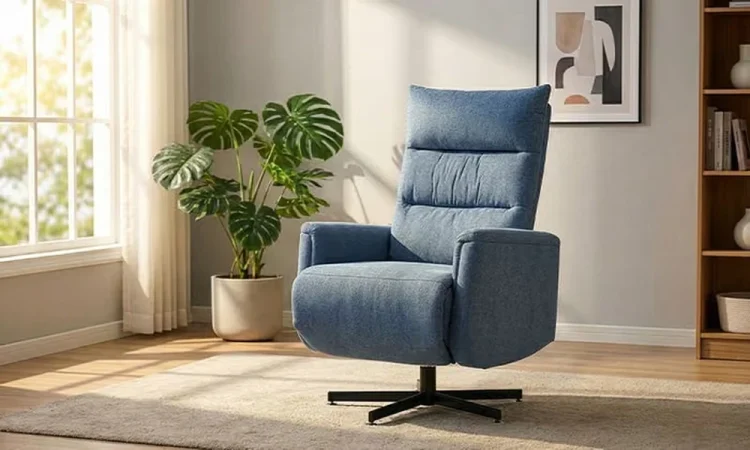
Most people buy a recliner the wrong way. They walk in, sit down for three minutes, decide it feels great, and haul it home. Then they realize it sticks out past the coffee table, blocks the bedroom hallway when it’s open, or swallows a smaller person whole. A recliner is a long-term resident in your living room, and picking one without a plan is one of the more expensive spontaneous decisions you can make.
The good news: this doesn’t have to be complicated. You just need to ask four questions in the right order before you ever step into a showroom or click “add to cart.”
The R.O.O.M. Framework: Four Questions Before You Buy
The R.O.O.M. Framework is a buying sequence designed to keep you from making the most common recliner mistakes. It stands for Room dimensions, Operation type, Occupant fit, and Materials. Work through them in that order, every time.
Room dimensions come first because nothing else matters if the chair doesn’t physically fit. Measure the footprint in both the upright and fully reclined positions. A standard recliner needs roughly 18 to 24 inches of clearance behind it to open completely. If you’re working with a tighter wall-to-sofa gap, that number alone could eliminate half the options on the floor before you start.
Picture this: a 14×16 ft living room already anchored by a three-seat sectional on one wall. You’ve got maybe 5 feet of space on the opposite side for a single accent chair. A standard recliner, fully extended, could eat every inch of that and hang over the rug edge. A wall-hugger recliner, which slides the seat forward rather than tipping the back outward, solves that problem neatly and gives you back several feet of breathing room.
Operation type is the mechanism question. Manual recliners use a side lever or push-back motion and cost less. Power recliners run on a motor and adjust with a button, which is genuinely useful if anyone in the house has joint stiffness or trouble pushing off a seat. The jump in price from manual to power can be real, so only pay it if someone will actually use the feature daily.
Occupant fit is the one people skip. Your feet should land flat on the footrest when you’re fully reclined, and the headrest should cradle your neck, not the top of your skull. If you’re shopping for multiple people with different heights, an adjustable power headrest becomes much more than a luxury.
Materials close the loop. Fabric holds up better in high-use family rooms and runs cooler in warm climates. Leather and bonded leather wipe clean easily but can feel stiff in a cold room. Microfiber sits in the middle. No material is universally “best.” The right one is the one that matches how your house actually gets used on a regular Wednesday.
Recliner Types: A Straight Comparison
The global recliner chair market reached USD 4.4 billion in 2024 and is projected to hit USD 6.8 billion by 2033, according to IMARC Group, reflecting a 5% compound annual growth rate over that period. That growth is fueled by a real shift in how people think about home seating, and the variety of recliner types has expanded to match. Here’s where each style belongs.
| Type | Best For | Space Need | Price Range |
|---|---|---|---|
| Standard Rocker Recliner | Family rooms, nurseries | Moderate (needs front clearance for rocking) | Budget-friendly |
| Wall-Hugger Recliner | Small living rooms, apartments | Low (as little as 4 inches from wall) | Budget to mid-range |
| Power Recliner | Users with mobility concerns, frequent recliners | Moderate (needs outlet nearby) | Mid to premium |
| Swivel Recliner | Open floor plans, media rooms | Moderate (needs rotation radius) | Mid-range |
| Lift Chair Recliner | Seniors, post-surgery recovery | Standard | Premium |
Rocker recliners are the most popular choice for everyday living rooms, and for good reason. They’re versatile, widely available, and usually the most affordable entry point. But if your room is small or your walls are close to where you’d want the chair, a wall-hugger should be your default unless something specific pushes you elsewhere.
What the Numbers Say About How Americans Spend on Furniture
According to the U.S. Bureau of Labor Statistics, average annual expenditures for all consumer units in 2024 were $78,535, with household furnishings representing a meaningful slice of that total. That figure matters because it tells you something about how seriously most households treat furniture purchases. A recliner isn’t an impulse buy for most families. It sits in the $400 to $2,000+ range depending on features, which means the wrong choice costs real money.
“Buy for the way you live on an ordinary Tuesday, not the way you want the room to look in a catalog.”
That advice captures exactly why so many recliners get returned or shoved into a corner within a year. Style is the last question, not the first. Pick the mechanism that fits your physical needs, the size that fits your room, and then pick the one you like the look of within that shortlist.
Why North America Leads Recliner Demand
North America holds the largest share of the global recliner market at around 40%, according to Data Horizzon Research, driven by high disposable income, a strong furniture retail industry, and growing demand for ergonomic home comfort products. That dominance is visible at the retail level too. Shoppers in the Southeast have access to a strong mix of national chains and local stores. If you’re exploring recliners near Spartanburg, SC, shopping in person lets you test the mechanism, check the footrest height against your legs, and see the actual upholstery color rather than a screen approximation. That alone is worth the trip.
The ergonomic angle matters too. A recliner that supports your lower back properly, with built-in lumbar curvature rather than just a flat padded seat, will feel better after an hour than one that seemed plush in the store. Press your lower back into the seat back when you test a floor model. If there’s a notable gap, the chair isn’t supporting your lumbar, and you’ll feel it within a week of daily use.
A Practical Pre-Purchase Checklist
Before you commit, run through these five items. Every one of them catches a mistake that’s annoying to fix after delivery.
- Measure twice: Write down the space’s width, depth, and the distance to the nearest wall or furniture piece. Bring those numbers with you.
- Test the mechanism cold: In the showroom, work the reclining lever or button five or six times. A mechanism that sticks or makes noise on the fifth try will not improve at home.
- Sit for five minutes, not thirty seconds: Most people test furniture for about twenty seconds. That tells you almost nothing. Sit long enough for the cushion to compress under your actual body weight.
- Check the clearance math: Ask a sales associate for the exact reclined depth. Add six inches for safety, then subtract that from your available wall space. You want a positive number.
- Confirm delivery logistics: Standard interior doors run about 30 inches wide. Some recliner boxes run wider than that. Measure your doorways and any tight hallway turns before delivery day.
Material Durability at a Glance
Fabric upholstery breathes better and is usually the more comfortable choice in warm climates like South Carolina summers. It shows wear over years but holds its shape well if the internal foam density is adequate. Test foam density by pressing firmly into the seat cushion with your hand. Cheap foam compresses almost to the frame. Quality foam pushes back.
Bonded leather is the material that surprises people. It looks great in the store and can peel within two to three years of regular use if it’s a low-grade version. If leather is important to you aesthetically, pay for genuine leather or choose a high-grade performance fabric that wipes clean like leather but doesn’t crack.
Microfiber sits in a practical middle ground. It’s soft, reasonably durable, handles pets and kids better than bonded leather, and comes in enough color options that you’re unlikely to feel limited.
The Real Test: Does It Earn Its Place?
A well-chosen recliner becomes the seat everyone argues over. A poorly chosen one becomes the seat nobody uses. The difference almost always comes down to getting the size and mechanism right before worrying about color or price.
Run the R.O.O.M. Framework, bring your measurements, and plan to sit in at least three floor models before deciding. If you do that, you’ll walk out with a chair that still feels like a good call five years from now. What’s the one feature you’d refuse to give up in a recliner?