
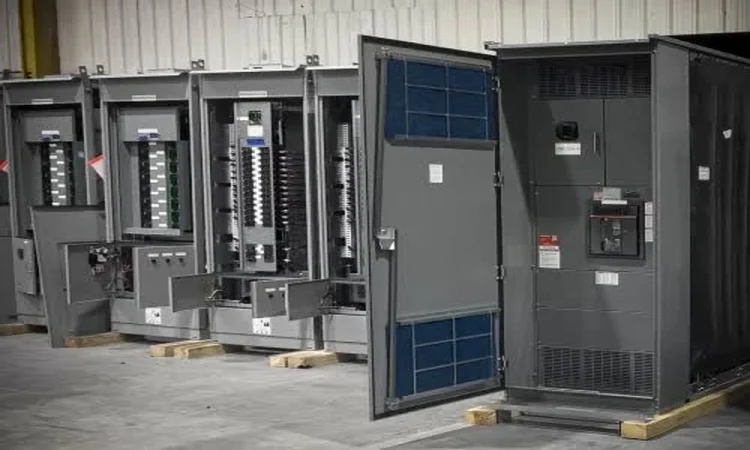

In commercial and industrial buildings, electrical distribution equipment comes in several forms that can look similar from the outside: large metal enclosures with breakers and meters inside. The terms switchboard, panelboard, and switchgear are often used loosely, but they describe different classes of equipment with different roles, standards, and capabilities.
In a typical distribution system, switchboards sit in the middle, taking power from the utility or a transformer and dividing it among large feeders. Understanding how they relate to panelboards and switchgear helps owners, engineers, and facility teams plan new projects and upgrades. Here is how the three compare.
Panelboards: Branch Circuit Distribution
Panelboards are the most familiar of the three. They distribute power to branch circuits for lighting, receptacles, and smaller equipment.
- Mounting: Usually installed in or on a wall.
- Access: Typically serviced from the front.
- Capacity: Handles lower currents than switchboards or switchgear.
- Standards: In North America, panelboards are commonly built to UL 67.
Switchboards: Feeder Distribution
Switchboards are free-standing assemblies that divide large incoming power into feeders serving panelboards, motor control centers, and major equipment.
- Mounting: Floor-standing, often in a dedicated electrical room.
- Access: Many designs are front-accessible, though some require rear access.
- Devices: Can include main and feeder breakers, fusible switches, and metering.
- Standards: Commonly built to UL 891.
Switchgear: Heavy-Duty Protection and Control
Switchgear is designed for the most demanding applications, where reliability, selective coordination, and maintenance access are top priorities.
- Construction: Breakers are often draw-out, so they can be removed for maintenance without de-energizing the entire lineup.
- Compartments: Components are typically separated by barriers.
- Ratings: Built to withstand high fault currents for longer durations.
- Standards: Low-voltage switchgear is commonly built to UL 1558 and related ANSI standards.
Key Differences at a Glance
- Role: Panelboards serve branch circuits, switchboards serve feeders, and switchgear protects and controls major distribution.
- Size: Panelboards are the smallest and switchgear is usually the largest.
- Maintenance: Switchgear offers the most flexibility for servicing individual components.
- Cost: Equipment cost generally rises from panelboards to switchboards to switchgear.
How They Work Together
In a typical commercial building, utility power enters through service equipment, which may be a switchboard or switchgear. From there, feeders run to panelboards on each floor or area, which then supply individual circuits. Larger facilities, hospitals, and data centers may use switchgear at the service entrance and switchboards further downstream.
Choosing the Right Equipment
- Available fault current: Determines the interrupting and withstand ratings needed.
- Reliability requirements: Critical facilities may justify switchgear for its maintenance flexibility.
- Space: Front-access designs suit tight electrical rooms.
- Future growth: Spare capacity and space for added sections reduce future disruption.
Engineers typically review manufacturer data alongside published NEMA standards when confirming equipment ratings and applications.
Safety and Compliance
Selection, installation, and maintenance of distribution equipment should be handled by qualified engineers and electricians. Designs must comply with the electrical code adopted locally and any utility service requirements.
The Right Fit for Every Level of the System
Panelboards, switchboards, and switchgear each have a clear place in a well-designed electrical system. Knowing what sets them apart helps project teams choose equipment that matches the load, the fault level, and the reliability the building needs.