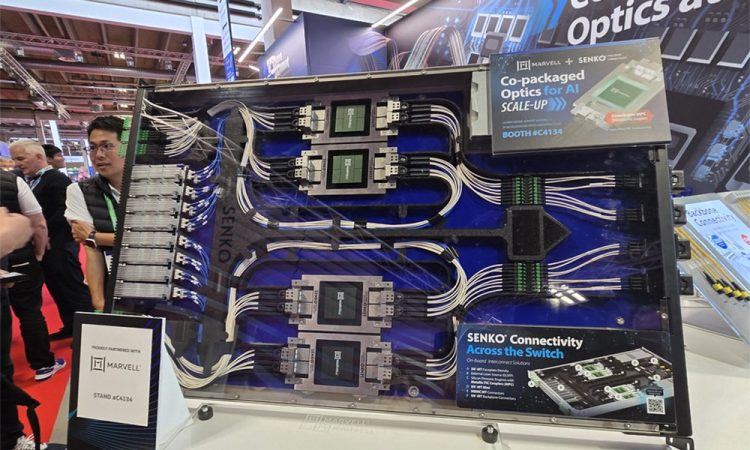
The data centre industry stands at a crossroads, and copackaged optics offers a path forward that addresses the most pressing challenges facing network infrastructure today. Artificial intelligence workloads have transformed from occasional computational experiments into the driving force behind data centre design, demanding unprecedented levels of bandwidth, power efficiency, and reliability. Traditional networking approaches, built around pluggable optical transceivers, struggle to keep pace with these evolving requirements. Understanding how copackaged solutions work and why they matter requires looking beyond the technical specifications to see how this integration fundamentally reshapes the economics and capabilities of modern networks.
Understanding the Technology
Co-packaged optics brings optical components directly onto the same package as switching silicon, creating an intimate connection between light and electronics that wasn’t previously possible. Imagine the difference between having a conversation across a room versus sitting beside someone. The closer proximity reduces the effort required to communicate clearly, and that same principle applies to data transmission.
In traditional systems, electrical signals travel through circuit boards, connectors, and cables before reaching optical transceivers that convert them to light. Each centimetre of that journey introduces loss, distortion, and delay. By placing optical components directly adjacent to the switch chip, copackaged optical technology eliminates most of this problematic pathway. The electrical connection shrinks from tens of centimetres to mere millimetres, fundamentally changing the physics of signal transmission.
This architectural shift doesn’t simply make existing approaches faster. It enables capabilities that weren’t feasible before, particularly at the multi-terabit speeds required for contemporary AI workloads.
Why AI Changes Everything
Artificial intelligence applications demand network characteristics quite different from traditional data centre workloads. Machine learning training, in particular, requires massive parallel data movement between computing nodes, creating what engineers call “all-to-all” traffic patterns. Every node needs to communicate with every other node, often simultaneously, generating network demands that dwarf conventional applications.
These AI workloads exhibit several distinctive characteristics:
- Extremely high bandwidth requirements between accelerator chips
- Sensitivity to latency and jitter that can slow training convergence
- Sustained traffic patterns rather than bursty behaviour
- Need for predictable performance without congestion-related variability
- Power budgets already stretched by computational requirements
Traditional pluggable optics weren’t designed with these demands in mind. The power overhead, latency penalties, and bandwidth limitations of front-panel transceivers become significant bottlenecks when supporting AI infrastructure.
Concrete Benefits for Data Centres
Copackaged optics technology delivers measurable improvements across multiple operational dimensions. Power consumption drops dramatically, with typical reductions of 30-50% compared to equivalent pluggable solutions. This efficiency matters enormously in modern facilities where power availability often limits computational capacity more than physical space.
The power savings come from multiple sources. Eliminating signal conditioning and retiming circuits removes substantial electrical overhead. Shorter signal paths require less drive strength. More efficient thermal design allows components to operate in optimal temperature ranges without excessive cooling power.
Port density increases substantially when optical interfaces no longer compete for front-panel real estate. A switch that might accommodate 32 pluggable ports can support 64 or more co-packaged optic connections, doubling effective bandwidth without increasing footprint. For data centre operators facing space constraints, this density advantage translates directly to capital efficiency.
Signal quality improvements enable higher data rates and more reliable operation. The shorter electrical paths in copackaged optical designs reduce crosstalk, electromagnetic interference, and impedance mismatches that plague high-speed signalling. Better signal integrity means fewer transmission errors, reduced retransmission overhead, and more consistent performance.
Singapore’s Manufacturing Expertise
Singapore’s advanced manufacturing capabilities have positioned the nation as a significant contributor to copackaged optics development. The precision required for optical alignment, the complexity of heterogeneous integration, and the stringent quality standards all align with Singapore’s established strengths in semiconductor packaging and photonics.
Manufacturing co-packaged optics demands extraordinary precision. Optical components must align to submicron tolerances to efficiently couple light between different elements. Singapore’s investment in advanced packaging infrastructure and skilled workforce enables this level of manufacturing sophistication.
The ecosystem advantages matter as well. Singapore hosts capabilities spanning silicon processing, optical component fabrication, precision assembly, and testing infrastructure. This concentration reduces supply chain complexity and enables faster iteration during development phases.
Implementation Realities
Adopting copackaged optics requires thoughtful planning beyond simple technology evaluation. The serviceability model differs fundamentally from pluggable approaches. When an optical transceiver fails in a traditional system, technicians replace the module in minutes. With copackaged solutions, the entire switch may require factory service or replacement.
This trade-off makes economic sense when considering overall system reliability. Removing pluggable connectors, which represent common failure points, can actually improve long-term reliability. The calculation shifts from minimising individual component replacement cost to optimising total cost of ownership over the system’s operational life.
Network architects must also consider the evolving standards landscape. Industry consortia continue developing specifications for optical interfaces, power delivery, and mechanical integration. Early deployments may face some degree of vendor specificity, but the trajectory clearly points toward standardised solutions that preserve operational flexibility.
The Path Forward
The technology trajectory is clear. As AI workloads become increasingly central to data centre operations, the infrastructure must evolve to support them efficiently. Copackaged optics addresses fundamental limitations in current approaches whilst enabling capabilities that weren’t previously feasible. The question isn’t whether this integration will happen, but how quickly the industry can scale manufacturing, establish standards, and update deployment practices.
For data centre operators planning infrastructure investments, understanding copackaged optics has become essential to making informed decisions about the next generation of networking equipment.